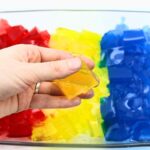
Gelatin Sensory Blocks
Does your toddler like to put everything in their mouth? These colorful gelatin sensory blocks are fun, easy to make and totally taste-safe!
Servings: 25 blocks
Calories: 1kcal
Equipment
- 1 whisk
- 1 standard 9x9-inch baking dish
- parchment paper
- 1 butter knife
Ingredients
- 1 ½ tbsp unflavored gelatin powder (two 7-gram packets)
- 2 ¼ cups water divided
- food coloring optional, as needed
Instructions
- Bring 1 ½ cups of water to a boil in a kettle or saucepan. If you wish to color your blocks, pour the boiling water into a glass measuring cup or bowl and stir in 15 drops of food coloring (or enough to achieve your desired saturation).
- Add the powdered gelatin to a medium mixing bowl. Pour the boiling water onto the gelatin and quickly whisk them together, continuing until the powder is completely dissolved. Add ¾ cup of cold water and whisk until combined.
- Line a square baking dish with parchment paper by gently pressing it onto the bottom, then slowly pour the gelatin mixture into the dish, carefully pressing down on the corners if needed to keep the parchment paper in place.
- Place the baking dish in the fridge and allow the gelatin to set for a minimum of 3 to 4 hours.
- Once the gelatin has set, take the baking dish out of the fridge. Carefully lift the parchment paper out of the dish and place it on a flat surface like a table or counter, then use a butter knife to cut the jelly into cubes.
Video
Notes
1. Storage instructions: Unused blocks can be stored in an airtight container in the fridge, with each color kept in a separate container, for 5-7 days. Discard immediately if you notice signs of spoilage like mold or an off odor.
2. Variations & substitutions: Try skipping the coloring to make clear blocks, making multiple batches in different colors to create a rainbow sensory bin, replacing the coloring with Kool-Aid powder to make the blocks scented, or replacing the gelatin with two 4-ounce boxes of Jell-O to make the blocks flavored. You can also add small, soft, taste-safe, non-chokable items like fresh flowers or small chunks of fruit.
3. Modifying the consistency: To make the blocks softer and reduce the risk of choking (for younger babies and toddlers), decrease the gelatin or increase the amount of water. To make the blocks firmer, increase the gelatin or reduce the amount of water.
4. Helpful tips:
- Whisk quickly: After pouring the boiling water onto the gelatin, start whisking immediately to prevent the gelatin from seizing up, and don’t stop until the powder has fully dissolved.
- Add fine motor practice: Use this activity as a way to let young children practice their cutting skills by adding plastic safety scissors and letting them cut the cubes into pieces. You can cut the jelly into strips instead of cubes to make this easier.
- Only use a few cubes: Instead of giving your child all the blocks to play with, take out a few blocks at a time and save the rest for later.
Nutrition
Calories: 1kcal | Protein: 0.4g | Sodium: 2mg | Potassium: 0.1mg | Calcium: 1mg | Iron: 0.005mg